Improved personalisation
Use customer context and interaction history to make an offer more relevant, and keep its message appropriate to the touchpoint.

Client implementation / Pega Customer Decision Hub
An implemented next-best-action experience connecting assisted call-center conversations and outbound email to Pega CDH. Both channels delivered relevant actions and returned interaction outcomes to the decision engine.
This describes a real client implementation. Client and environment identifiers are omitted.
01 / Shared foundation
Taxonomy, action content and channel treatments provide the structure for the decisioning experience.
Configured strategies evaluate candidate actions against customer and business context, then return ranked next-best actions for a channel.
Real-time and outbound integrations used the same CDH decisioning foundation while recording channel-specific outcomes.
02 / Customer experience principles
Decisioning connects customer relevance with business priorities, then makes that choice usable in each channel.
Customer strategy and lifecycle marketing provide a shared foundation for these principles.
Use customer context and interaction history to make an offer more relevant, and keep its message appropriate to the touchpoint.
Give marketing, product and channel teams a shared action catalogue and decision framework to shape joined-up customer journeys.
Balance predicted response, current context and business value; connect decision outcomes to the measures used to refine future choices.
From disconnected campaigns toward more consistent, individually relevant offers.
03 / Before delivery
Each channel request draws on the same decision foundation. Policies narrow the candidate set; arbitration ranks what remains.
Organise offers under the business taxonomy—such as sales, acquisition, retention and mandatory actions. Each action can carry treatments that provide the message and content for a particular channel.
Configured policy conditions assess the customer–action match before an offer is considered for delivery.
Contact policies use recorded exposure and response history to suppress over-contacted actions. Channel limits add delivery-specific controls, especially for outbound communication.
Arbitration balances the predicted likelihood of customer response with contextual relevance and business priorities.
CDH returns ranked action data. The integration selects a suitable treatment and presents the offer in the channel context—for example, an offer tile for an agent or content in an outbound email.
04 / Assisted call-center channel
The interaction portal requested offers through the Real-Time Container, rendered the returned action data, and captured presentation and agent feedback.
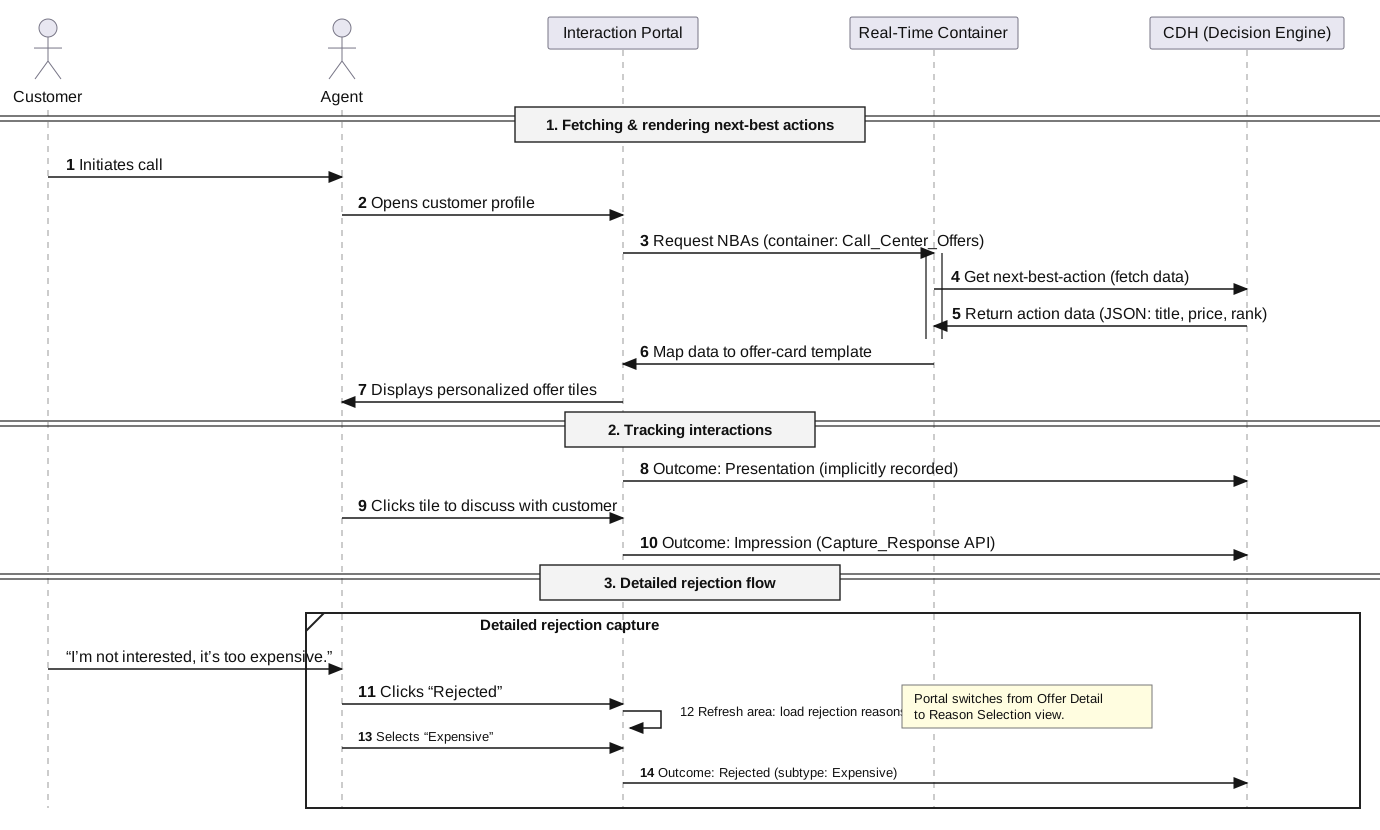
The customer calls; the agent opens the customer profile in the interaction portal.
The portal requests next-best actions for Call_Center_Offers through the Real-Time Container.
The container asks CDH to evaluate the customer and returns action data such as title, price and rank.
The container maps the response to the offer-card template; the portal displays personalized tiles to the agent.
Presentation was implicitly recorded. When the agent selected a tile to discuss, the portal sent an Impression outcome through the Capture_Response API.
If the customer declined, the agent selected Rejected. The portal opened a reason list; choosing “Expensive” sent a Rejected outcome with subtype Expensive to CDH.
Presentation → Impression → Rejected (reason) The event trail distinguishes an offer being presented, an agent choosing to discuss it, and the customer’s explicit rejection reason.
05 / Outbound email channel
A batch process generated NBA email records for the ESP. Delivery, open, click and negative feedback events were reported back to CDH.
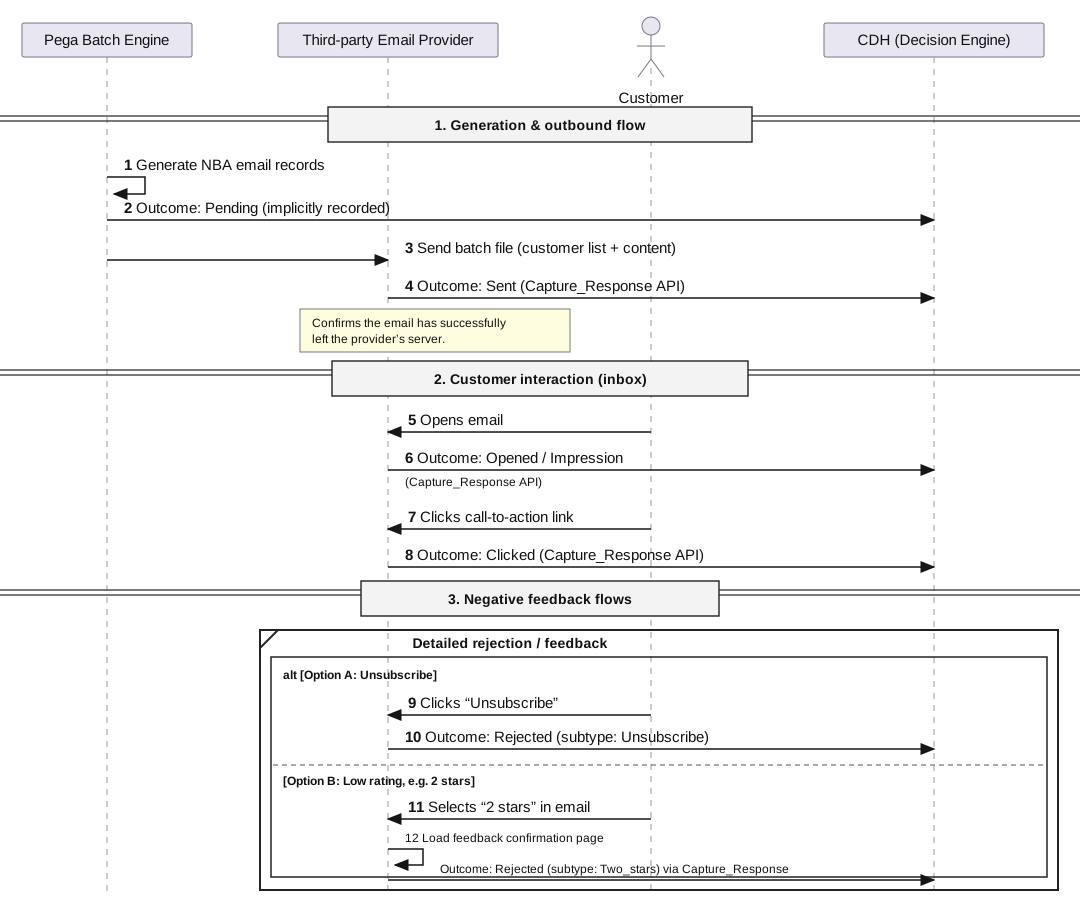
The batch engine generated the customer list and email content; Pending was implicitly recorded for the outbound action.
The customer list and content were passed to the third-party email service provider.
The ESP sent a Sent outcome through Capture_Response, confirming the email had successfully left the server.
Opening the email produced an Opened / Impression outcome. Following its call-to-action link produced a Clicked outcome; both were sent through Capture_Response.
Unsubscribing produced Rejected with subtype Unsubscribe. Selecting a low email rating (for example, two stars) loaded a feedback confirmation page and recorded Rejected with subtype Two_stars.
Pending → Sent → Opened / Impression → Clicked → Rejected (reason) Explicit response events were returned through Capture_Response to CDH.
06 / Close the loop
Linking outcomes to the decision and action gives CDH a usable record of what happened after delivery.
Recorded interaction history can inform future context and contact-policy suppression according to the configured solution.
Responses can train adaptive models when the relevant models and response mappings are configured. Updated predictions can then contribute to future arbitration.
The channel events above describe the implemented integrations. How captured responses affect contact policies and adaptive models depends on the corresponding CDH configuration.
Experience